
NDT Services
Non-Destructive testing round the clock. Our highly committed team of NDT / QC / Welding inspectors and supporting staff is equipped with the latest tools and technology to satisfy the requirements of the Clients and Class in time and in the most professional manner.
Type of Services
Ultrasonic Testing (UT)
Ultrasonic Testing (UT) is an NDT method using high frequency sound energy above the human hearing level of 20 kHz, and is produced by a piezoelectric crystal (transducer) which converts electrical energy into mechanical vibrations, and back to electrical energy for interpretation of the electronic signal. Ultrasonic testing is capable of detecting surface and subsurface defects and/or discontinuities, and is commonly used for measuring material thickness and for detecting flaws in newly manufactured or in-service components. Ultrasonic inspection is performed on and not limited to welds, castings, forgings, pipe, fittings, valves, machined parts, pressure vessel and for the detection of steelplate laminations


Magnetic Particle Testing (MT)
Magnetic Particle Testing (MT) is a non-destructive testing method used to detect surface and slightly subsurface flaws in ferromagnetic materials (such as carbon steel). It is used routinely to inspect welds, piping, pressure vessels and structural steel components.
The area to be inspected is prepared and ferrous iron particles are applied to the part.The piece is then magnetized by direct or indirect magnetization, whereas the presence of a surface or subsurface discontinuity in the material allows the magnetic flux to leak.If an area of flux leakage is present the ferrous particles will be attracted to this area,resulting in an indication. The indications interpreted in accordance to applicable procedures and specification requirements
Radiographic Testing (RT)
Radiographic Testing (RT) one of the primary non-destructive test methods. RT uses X-Ray generated by means of high voltage and Gamma Rays (Ir-192, Co-60,Cs-137) produced by natural disintegration of nuclei in radiative isotope. Radiation testing is working on the principle of penetration and absorption of X and gamma radiation.
RT can be used to detect internal discontinuities in almost any material that is not too thick. X-ray machines capable of penetrating as much as 26 inch of steel and greater thickness of other materials are available. RT can disclose internal structures, configuration, fluid levels and fabrication or assembly errors. RT Testing provides image film of the test object that could be kept as permanent record. RT isotopes are portable and used for field testing.
The result is a two-dimensional projection of the part onto the film, producing a latent image of varying densities according to the amount of radiation reaching each area. Recorded latent image can be visible after development.


Visual Inspection (VI)
Visual Inspection (VI) is the most common non-destructive testing methods which requires adequate illumination of the test surface and proper eye-sight of the tester. Visual inspection is the process of examination and evaluation of systems and components by use of human sensory systems aided only by mechanical enhancements to sensory input such as magnifiers, handheld tools, boroscope etc., as applicable.
Eddy Current Testing (ET)
Eddy Current Testing (EC) is an electromagnetic technique and can only be used on conductive materials. Its applications range from crack detection, to the rapid sorting of small components for either flaws, size variations, or material variation. The main advantage is that testing can be conducted without the need to remove paint or surface coatings.
When an energised coil is brought near to the surface of a metal component, eddy currents are induced into the specimen. These currents set-up magnetic fields that tend to oppose the original magnetic field. The impedance of a coil in close proximity to the specimen is effected by the presence of the induced eddy currents in the specimen.
When the eddy currents in the specimen are distorted by the presence of the flaws or material variations, the impedance in the coil is altered.


Hardness Testing HT
The hardness of a material usually is considered resistance to permanent indentation. In general, an indenter is pressed into the surface of the metal to be tested under a specific load for a definite time interval, and a measurement is made of the size or depth of the indentation.
The principal purpose of the hardness test is to determine the suitability of a material for a given application, or the particular treatment to which the material has been subjected which will provide information relationship between hardness and other properties of material.
Phased Array Ulrasonic Testing (PAUT)
Phased Array Ultrasonic Testing (PAUT) systems offer the greatest possibility of performing inspections with the ultrasonic beams of various angles and focal lengths using a single array of transducers. Software control over the beam angles and focusing is achieved by application of precisely controlled delays to both the emission pulse and received signal for each element in an array of transducers, hence the term, “phased array”.
The benefits of phased array technology over conventional UT come from its ability to use multiple elements to steer, focus and scan beams with a single transducer assembly. Beam steering, commonly referred to as sectorial scanning, can be used for mapping components at appropriate angles. This can greatly simply the inspection of components with complex geometries.The ability to test welds with multiple angles from a single probe greatly increases the probability of detection of discontinuities and anomalies.


Time of Flight Diffraction (TOFD)
Time of Flight Diffraction (TOFD) uses the time of flight of an ultrasonic pulse to determine the position of a reflector. In a TOFD system, a pair of ultrasonic probes sits on opposite sides of a weld. One of the probes, the transmitter,emits an ultrasonic pulse that is picked up by the probe on the other side, the receiver. In undamaged pipes, the signals picked up by the receiver probe are from two waves: one that travels along the surface and one that reflects off the far wall. When a crack is present, there is a diffraction of the ultrasonic wave from the tip(s) of the crack. Using the measured time of flight of the pulse, the depth of a crack tip can be calculated automatically by simple trigonometry.
Positive Material Identification (PMI)
Positive Material Identification (PMI) enables a component’s material grade or chemical composition to be determined. PMI is one of the more specialized non-destructive testing (NDT) methods. With the usage of positive material identification the alloy composition of materials can easily be determined. If a material certificate is missing or it is just not clear what the composition of a material is, the use of positive material identification offers the solution. PMI is particularly used for high quality metals like stainless steel and high-alloy metals.

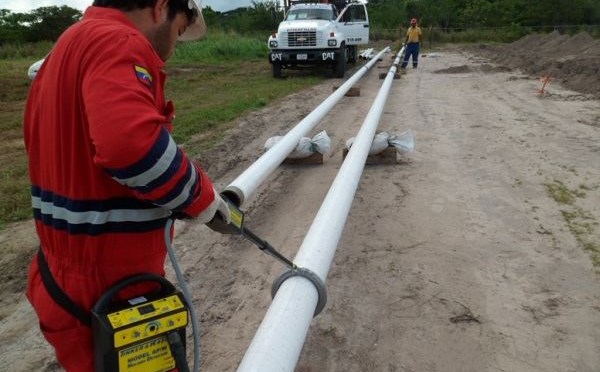
Holiday Testing
Holiday Testing is a non-destructive test method applied on protective coatings to detect unacceptable discontinuities such as pinholes and voids. The test involves checking an electric circuit to see if current flows to complete the circuit. If an electrical flow is detected, then the test area is termed as conductive, indicating the presence of discontinuities such as pinholes and voids. This testing is used to find coating film discontinuities that are not readily visible.A holiday test is performed with a holiday detector, which is an electrical device used to determine the location of a gap or void in the coating.
Post Weld Heat Treatment (PWHT)
In order to ensure the material strength of a part is retained after welding, PWHT is performed. PWHT can be used to reduce residual stresses, as a method of hardness control and to enhance material strength. Preheating involves rising the temperature of the parent material locally, on both sides of the joint to a value as refereed in weld procedure and aids welding to control rate of cooling, diffusion rate of hydrogen and reduce thermal losses.
